Whole life policy: A term assurance
plan with an unspecified period, under which sum assured is paid on death.
This plan is mainly devised to create an estate for the heirs of the
policyholder as the plan basically provides for payment of sum assured plus
bonuses on the death of the policyholder
Endowment assurance plan: A term
insurance plan along with pure endowment plan, under which SA is paid on
survival of the specified period or on earlier death. This plan is a
traditional plan and used well by the people to save money. This policy has
paid up value and has maturity value which is dependent on the performance of
the fund of the company but more or less assured.
Money back policy: under which
normally 20% of sum assured is paid on survival every 5 years and 40% on
survival for 20 years and full SA on death at any time within 20 years.
Typically this plan is the combination of 4 pure endowment of varying period
ans 1 term plan for 20 years.
Convertible Plan:
- Convertible plans provide in its terms and conditions, that it can be changed another plan after or within a certain period after commencement
- Example: A term plan can be converted to whole life policy or an endowment policy within a period specified in the original plan. Normally that period is not later than 2 years before the expiry of the original plan
- If the original term insurance cover is for 5 years, the option to convert should be exercised before the end of 3rd year
Advantage:
- No medical examination on conversion
- No further underwriting decision
Such policies are usually
taken by persons in early stages of their career, who expect their financial
condition to improve in future, but would not like to delay the benefits of
insurance.
With Profit and Without Profit Policies
Without profit/ Non-participating policy: Not entitled to bonuses which are declared after actuarial
valuation
With profit/ Participating policy: Premium is slight higher because of the right given to
participate in the progress of insurer. With profit policies are popular
because of the bonuses are expected to be more than the extra premium paid.
Joint Life Policy:
- Two or more lives can be covered under one policy
- Usually cover married couples or partners
- The SA is paid on the death of any of the insured persons during the term or at the end of the term
- Some plans also provide payment of SA on the death of one life and the policy is continued to cover the second life till maturity without payment of further premium
Children Plan
- Insurance is taken on the lives of minor children, proposal will be made by parents
- Risk on the life of the insured child begins only when child attains a specified age
Deferment period: Time
gap between the date of commencement of policy and commencement of risk.
Deferred date: The
date on which risk will commence. There is no insurance cover during deferment
period. Risk will commence automatically on deferred date. Low premium is main
advantage.
Remember: Life of the children can not be covered
because insurance is a contract and contract with minor is a void contract.
Hence if you practically observe, you will find that in the children plan as
well life assured is of parents.
Riders
- A rider is a clause or condition that is added to a basic policy providing an additional benefit, at a choice of proposer
- Insurers find it convenient to have small number of basic plans, and riders being offered as option
Some of the riders:
1.
Accident death benefit allowing double the SA if death happens
due to accident
2.
Permanent disability benefit
3.
Cover to meet major surgical expense
Annuity Plan
Annuity means a series of payments made at successive
periods or intervals of time is called annuity
Example: salary, loan repayment, SIP
Number of lives covered
Single: provides the annuity to the single
annuitant during his lifetime
Annuitant means the person who buys an annuity plan.
Joint: Payments to be made during the life
time annuitant and his/her spouse and to be stopped on the death of the last
survivor
Immediate Annuity : If the successive payments are made at
the end of successive period or interval
Annuity Due: If the
successive payments are made at the beginning of the successive period or
interval
The plans offered by the insurance companies are useful for the
people who have retired and are worried about the income stream and longevity.
Annuity Rate:
Amount of annuity payable at yearly intervals which can be purchased for Rs. 1 lakh under different options is as under:
Amount of annuity payable at yearly intervals which can be purchased for Rs. 1 lakh under different options is as under:
Age last birthday
|
Yearly annuity amount under option
|
|||||
( i )
|
( ii ) (15 years certain)
|
( iii )
|
( iv )
|
( v )
|
( vi )
|
|
40
|
7510
|
7440
|
6930
|
5610
|
7310
|
7120
|
45
|
7770
|
7660
|
6960
|
5890
|
7500
|
7240
|
50
|
8140
|
7950
|
7000
|
6280
|
7760
|
7420
|
55
|
8650
|
8330
|
7050
|
6810
|
8130
|
7670
|
60
|
9350
|
8790
|
7110
|
7530
|
8640
|
8030
|
65
|
10410
|
9330
|
7180
|
8590
|
9400
|
8570
|
70
|
12080
|
9830
|
7260
|
10220
|
10560
|
9370
|
75
|
14510
|
10220
|
7360
|
12590
|
12240
|
10590
|
Paid-up
value:
The policy does not acquire any paid-up value.
Surrender Value : No surrender value will be available under the policy.The policy does not acquire any paid-up value.
Loan : No loan will be available under the policy.
These plans have been of
great success in recent years. It is a hybrid plan which gives an option of
choosing the investment portion to the insured. It combines the benefit of life
insurance as well as giving various options of participating in the growth of the
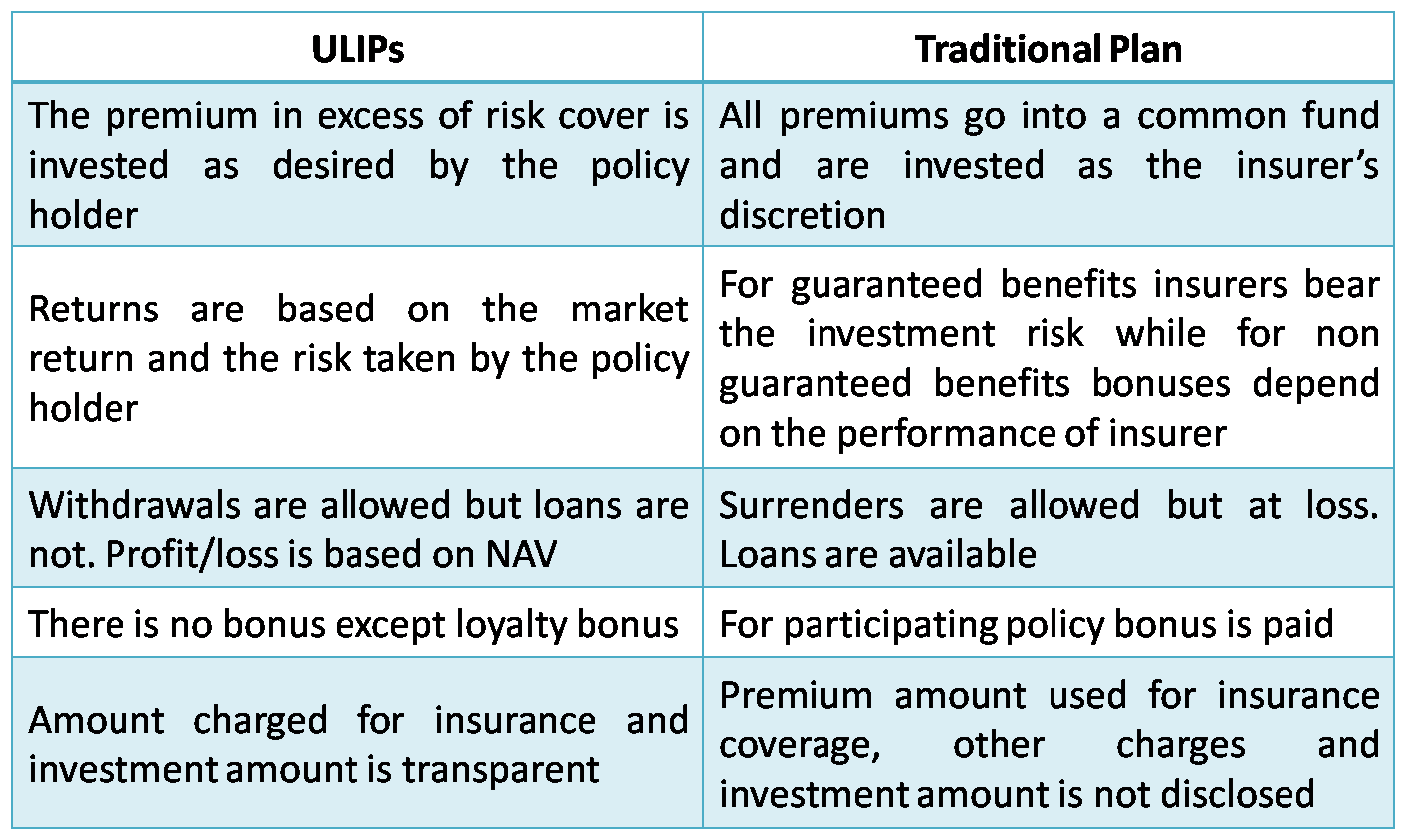
capital market. The traditional plan of insurance companies never disclose
to insured where his money is invested. This non transparency part is
eliminated by the linked plans. The SA or death cover, payable in the event of
death during the term, is related to the premium usually as multiple like 5
times the annual premium. IRDA guideline: SA has to be 1.25 times for single
premium or 5 times in case of annual premium.
When we talk about
transparency and facilities we should also consider the charges of linked
plans. They are as follows:
1.
Premium Allocation Charge
2.
Mortality Charges
3.
Fund Management Fees
4.
Policy/ Administration Charges
5.
Surrender Charges Service Tax Deductions
Investors may note, that
the portion of the premium after deducting for all charges and premium for risk
cover is utilized for purchasing units.
Lets also understand the
difference between the traditional plans and the linked plans

Before choosing any life insurance product one must consider the
following:
1. Adequacy
of coverage
2. Cash
outflow/ amount of premium
3. Duration
of need
4. Expenses
of the policy
5. Surrender
charges
However there are several methods to evaluate the various life
insurance policies.
Belth Method
The Belth yearly price of protection method enables to determine
whether a given life insurance policy is competitively priced based on the
annual cost per Rs. 1,000 of protection.
Simply put, it weighs costs against coverage.
The Belth yearly rate of return method allows to determine
whether the rate of return on the investment component of a given policy is
good, fair, or poor.

Try to solve above equation with following:
Post Tax Interest Rate = 12%
Annual Premium = Rs. 10000
Bonus = Rs. 15000
Death Benefit = Rs. 10 lacs
CSV = Rs. 5,00,000
CVP = Rs. 4,60,000
Internal Rate of Return
Commonly used for policy evaluation purposes in business
purchases of life insurance
Surrender-Based IRR
Solves for the IRR/interest rate/yield that causes accumulated
premiums (less any bonus paid)to equal the policy CV at one or more
pre-selected policy durations
Typically, highly negative (with a limit of a negative 100
percent) in early years (short durations) and becomes less negative, and
increasingly positive, with longer durations
Death-Based IRR
Solves for the IRR/interest rate/yield that causes accumulated
“net” premiums to equal the Face Amount at one or more selected policy
durations
In early years (short durations), this IRR will be very large
but declines with longer durations (i.e., the longer the insured lives)